
Why BMW stayed with the inline six
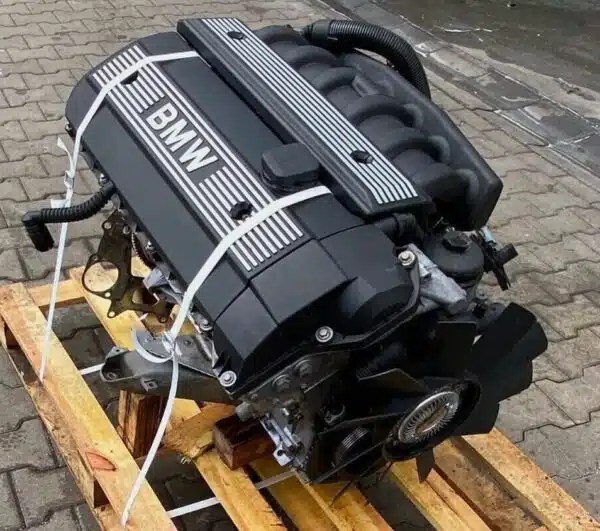
Few engine layouts are as closely associated with one manufacturer as the inline six is with BMW. An inline six is naturally well balanced: the forces created by its pistons largely cancel each other out without the balance shafts that a four-cylinder or a V6 may need. The result is the smoothness BMW drivers describe, in a layout that is long but narrow and therefore suits a longitudinal engine in a rear-wheel-drive car.
While many manufacturers moved to V6 engines to save length, BMW kept the straight six through every generation of its mainstream saloons. That continuity is useful for anyone sourcing a replacement engine today, because the families follow a recognisable lineage. Knowing where an engine sits in that lineage explains its strengths, its known weaknesses, and why engines that look similar are rarely interchangeable.
The first generation: M30 and M20

The M30, introduced in the late 1960s, was the large six that powered BMW’s saloons, coupés and luxury models for more than two decades. It used a cast-iron block, an aluminium cylinder head and a single overhead camshaft driven by a chain. In capacities from around 2.5 to 3.5 litres it earned a lasting reputation for durability, and versions of it remained in 5, 6 and 7 Series models into the early 1990s.
Alongside it, the smaller M20 arrived in the late 1970s for the compact and mid-size cars, most famously the E30 3 Series. It also used a single overhead camshaft, but driven by a toothed belt rather than a chain, which made belt changes a routine part of ownership. The M20 established the small BMW six as an everyday engine rather than a luxury, and it set the pattern for the compact sixes that followed.
Twin camshafts and VANOS: M50, M52 and M54

The M50 replaced the M20 at the start of the 1990s and brought four valves per cylinder and twin overhead camshafts driven by chain. It powered the E34 and E36 and soon gained single VANOS, BMW’s variable timing for the intake camshaft. Power and flexibility improved markedly, and the chain drive ended the belt-change routine that M20 owners had grown used to.
The M52 followed in the mid-1990s with an aluminium block, and the later M52TU added double VANOS, adjusting the exhaust camshaft as well as the intake. The M54 refined the formula up to 3.0 litres for E46, E39, E60, E83 and E53 models. These engines remain popular because they are mechanically straightforward, but cooling-system plastics, VANOS seals and crankcase ventilation are well-known service items on any example sourced today.
The N generation: Valvetronic and turbocharging
The N52, introduced in the mid-2000s, combined double VANOS with Valvetronic, BMW’s variable intake valve lift, and used a crankcase combining magnesium and aluminium to save weight. It appeared across the 1, 3, 5 and X ranges and remains one of the most widespread naturally aspirated BMW sixes on the used market, which makes it a frequent replacement request.
The N54, launched in the E92 335i coupé, brought turbocharging back to BMW’s mainstream petrol six. It used two turbochargers and direct injection, delivered a dramatic increase in low-speed torque, and quickly became popular with tuners. Its successor, the N55, replaced the twin turbochargers with a single twin-scroll unit and added Valvetronic, simplifying the layout while keeping broadly similar performance in the mainstream models.
For a replacement buyer, this generation is where family boundaries matter most. An N52, an N54 and an N55 can share a body style and a badge across facelifts, yet their electronics, fuel systems, cooling and exhaust layouts are completely different. A car built with one of them needs that engine, in the version that matches its build date.
The modular era: B58
The B58 arrived in the mid-2010s as part of BMW’s modular engine family, in which three-, four- and six-cylinder petrol and diesel engines share a common cylinder size of around half a litre. It retains a single twin-scroll turbocharger, direct injection, Valvetronic and double VANOS, but with a closed-deck aluminium crankcase and a charge-air cooler built into the intake system.
The B58 has powered models from the 340i and 440i to the M340i, M440i, X3, X5 and Z4, and it has a reputation for strength and refinement. It is also the clearest example of why later engines are not simple drop-ins for earlier cars: the B58 is designed around newer electronics, mounts and cooling, and fitting it to a car built with an N55 is a conversion rather than a replacement.
Within the B58 there are revisions, usually reflected in the letters at the end of the code, and later versions differ in detail from the first. As with every family, the full engine code and the build year of the car decide the correct unit, and two B58 engines from different years should never be assumed to be identical.
The diesel sixes alongside
BMW’s diesel sixes followed a parallel path. The M21 of the 1980s and the M51 of the 1990s gave way to the M57, which made the 30d badge famous in the 3, 5 and 7 Series and the X5. The N57 followed with an aluminium crankcase and a timing drive at the rear of the engine, and the B57 brought the diesel six into the modular family alongside the B58.
This guide concentrates on the petrol sixes because their history runs from the M30 to the B58 in one unbroken line, but the same lesson applies to the diesels: a shared badge across generations hides different engines with different fitment. bavarianenginesstore.shop lists the diesel sixes in the same way as the petrol engines, by code, by year and with photographs of the unit being sold.
What the history means when you buy
History is not trivia when a car needs a replacement engine. It explains why an M54 car cannot take an N52 without major work, why an N54 and an N55 are separate orders even in the same model, and why a B58 is never supplied against an N55 car. Each generation changed something fundamental: the camshaft drive, the valve control, the induction, or the electronics that run the engine.
The practical method is the same throughout. Read the engine code from the VIN or the crankcase, note the suffix, check the build date and the gearbox, and order the listing that matches. bavarianenginesstore.shop lists engines by code and photographs each unit, so the history set out in this guide can be checked against the actual engine on the page before an order is placed.
Warranty
Many engines come with up to 12 months warranty. A proper workshop must fit the engine. The warranty is for a fault inside the engine. It does not cover the wrong engine, a dry start, the wrong oil, or damage done after you open the crate.
Shipping
Crate shipping from Hamburg costs 299 EUR. We pack the engine in a strong crate and send it to the address on your order. You need a forklift or an engine crane to unload it.
FAQ
Which BMW straight six was the first with VANOS?
Variable intake cam timing arrived on the M50 in its updated form in the early 1990s. Double VANOS, which adjusts both camshafts, followed on later engines such as the M52TU.
Can an N55 be replaced with a B58?
Not as a direct replacement. The B58 uses different electronics, mounts and cooling, so fitting it to an N55 car is a conversion project rather than an engine swap.
Is the M54 still a sensible replacement engine?
For a car built with an M54, yes, provided the unit is inspected and the code matches. Plan to renew ageing cooling-system plastics and check the crankcase ventilation when it is fitted.
Do you ship straight-six history to my door?
Yes. Crate shipping from Hamburg costs 299 EUR to the address on your order.
How long is the warranty?
Up to 12 months on many engines, for a fault inside the engine, after a proper fit. See the warranty page for the full rules.
Are the photos of the real engine?
Yes. When you buy Bavarian Engines Store engines from us, the photos are real photos from our yard, not made-up pictures.
Can you check my VIN first?
Yes. The VIN check is free. Send it before you pay and we confirm the engine fits.


